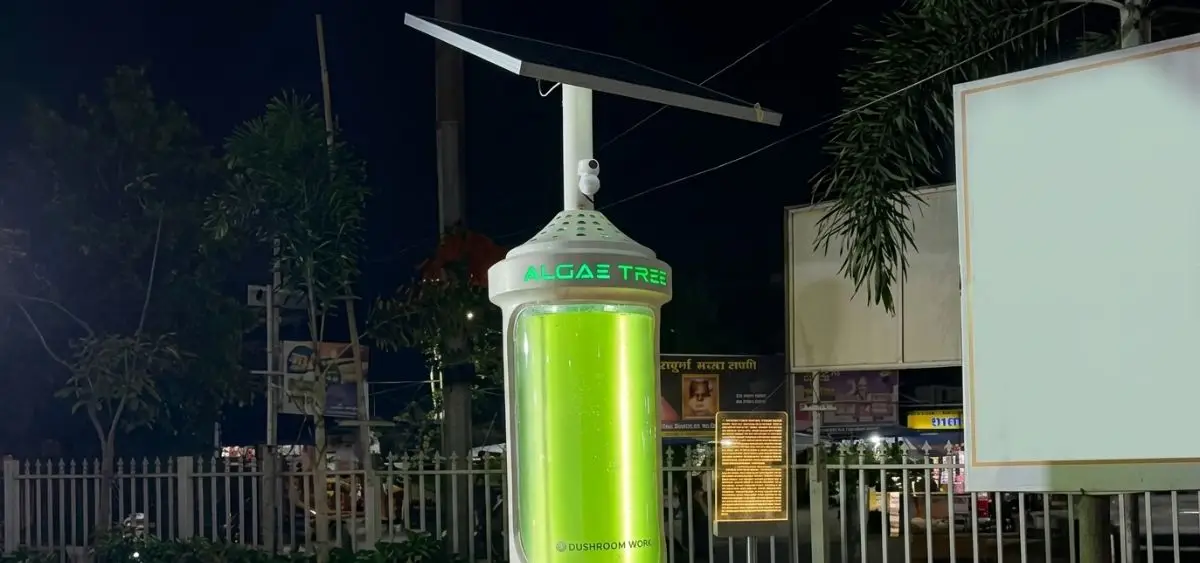

Air pollution is becoming a serious issue in cities across the world. Rising vehicle emissions, industrial smoke, and the continuous loss of green spaces are making it harder for urban areas to maintain healthy air quality. To address this growing problem, India has introduced an innovative environmental solution known as the “Algae Tree.”
This modern technology is created to reduce pollution in a smarter and more eco-friendly way. Instead of using branches and leaves like regular trees, the Algae Tree uses microalgae to absorb carbon dioxide and release oxygen while occupying very little space. India’s first Algae Tree installation in Bhopal recently went viral online and started discussions about how future cities can become cleaner and more sustainable.
What Is an Algae Tree?
An Algae Tree is an innovative air-cleaning system that uses living microalgae to reduce pollution in cities. It is built to absorb carbon dioxide (CO₂) from the environment and help improve urban air quality.
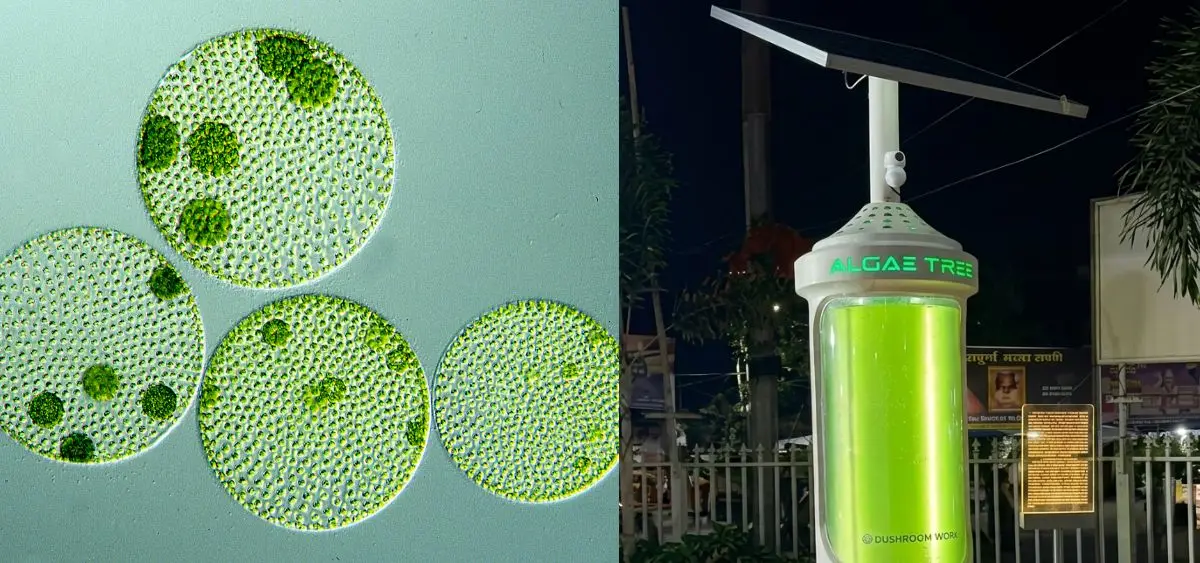
Unlike traditional trees that rely on branches and leaves, this modern structure contains algae inside a transparent vertical unit. These microalgae carry out photosynthesis naturally, taking in CO₂ and releasing fresh oxygen into the air.
The idea blends environmental science with smart technology to create a compact solution for crowded urban areas. This climate-tech project has been developed by Mushroom World Group through its green initiative, AlgaeTree.
How Does an Algae Tree Work?
An Algae Tree works through a natural process powered by microalgae. Inside the transparent structure, tiny algae are grown using sunlight, water, and essential nutrients. These microalgae absorb carbon dioxide from the surrounding air and release oxy54gen through photosynthesis, helping improve air quality in polluted urban areas.
The system is designed with modern smart technology that monitors its overall performance and environmental conditions in real time. Some Algae Trees also use solar energy support, which makes them more sustainable and energy-efficient.
Based on the company’s information, a single Algae Tree can absorb nearly 1.5 tons of carbon dioxide every year while generating around 1 ton of oxygen annually. It may also help lower dust particles and improve the local Air Quality Index (AQI) around its installation area.
Why Cities Need Algae Trees?
Cities are growing faster than ever, but the number of green spaces is slowly shrinking. In many urban areas, there is very little room left to plant enough trees because of buildings, roads, and heavy development. Meanwhile, air pollution keeps increasing due to traffic, industries, and construction work.
Algae Trees offer a smart solution for such crowded places. Because they take up less space, they can be installed in areas like busy roadsides, commercial zones, parks, and industrial locations where traditional tree plantation may not be possible.
However, Algae Trees are not designed to replace natural trees. Their purpose is to support cities by improving air quality in places where creating large green spaces is difficult. This makes them a useful option for smart cities and pollution-prone urban environments.
Benefits of Algae Trees
1. Absorbs Carbon Faster
Algae Trees use microalgae that can capture carbon dioxide at a much faster rate than many regular plants. This makes them useful for reducing pollution in traffic-heavy and industrial areas.
2. Needs Very Little Space
Traditional trees require large land areas to grow properly, but Algae Trees are designed vertically and take up minimal space. Because of this, they can easily be installed in crowded cities.
3. Helps Improve Air Quality
Apart from absorbing CO₂, Algae Trees may also help lower harmful particles present in the air. This can contribute to cleaner surroundings and better air quality in urban locations.
4. Eco-Friendly Technology
Many Algae Tree systems are built with smart technology such as cloud-based monitoring, telemetry features, and solar-powered support. This makes them a sustainable and modern environmental solution.
5. Supports a Greener Future
As countries focus on lowering carbon emissions and achieving climate goals, technologies like Algae Trees can play an important role in building cleaner and more sustainable cities.
Algae Tree vs Traditional Trees
Traditional trees play a major role in protecting the environment. They support wildlife, improve biodiversity, reduce heat, and maintain the natural balance of ecosystems. However, in crowded urban areas where space is limited, Algae Trees provide some practical advantages.
| Feature | Algae Tree | Traditional Trees |
|---|---|---|
| Space Needed | Compact and vertical | Requires larger land area |
| CO₂ Absorption | Faster carbon capture | Natural absorption process |
| Technology Support | Smart monitoring systems | No digital monitoring |
| Installation in Cities | Easy in small spaces | Difficult in congested areas |
| Wildlife & Biodiversity Support | Minimal | Strong ecological support |
| Environmental Impact | Supports air purification | Provides complete ecosystem benefits |
It is important to understand that Algae Trees are not designed to replace natural trees or forests. Instead, they are created as an additional solution for urban spaces where planting enough greenery is challenging.
Challenges and Limitations
Even though Algae Trees are an innovative solution for cleaner cities, they still come with a few challenges that need attention.
- Expensive Installation and Setup: Building and operating an Algae Tree system can cost more than planting regular trees. The technology uses special equipment, monitoring systems, and controlled environments, which increases the overall expense.
- Regular Maintenance Is Necessary: Unlike natural trees that grow on their own, Algae Trees need continuous care. The algae inside the system require proper water flow, sunlight, nutrients, and regular cleaning to function efficiently.
- Still a New Technology: Algae Tree technology is still developing in India. Because of this, experts need more time and research to understand its long-term environmental impact and effectiveness on a larger scale.
- Not a Replacement for Natural Trees: Although Algae Trees can help reduce pollution in cities, they cannot replace the environmental value of forests, parks, and traditional green spaces. Natural trees support biodiversity, provide shade, and create healthier ecosystems that technology alone cannot fully recreate.
The Future of Algae Trees
With air pollution becoming a serious issue in many urban areas, cities are now looking for smarter and more sustainable environmental solutions. Algae Trees are emerging as one of the innovative technologies that could support future smart city projects, especially in places where there is very little space for traditional greenery.
These systems combine microalgae technology, carbon capture, and smart monitoring to help improve air quality in crowded city environments. As research and development continue, Algae Trees may become more efficient and widely used in public spaces, commercial areas, and highly polluted zones.
Environmental experts believe that future cities will need both natural green spaces and advanced eco-friendly technologies to tackle climate change effectively. In that future, Algae Trees could serve as an additional tool to support cleaner and healthier urban living.
Conclusion
The Algae Tree is an innovative step toward creating cleaner and more sustainable cities. By using living microalgae to absorb carbon dioxide and release oxygen, this technology offers a modern approach to reducing urban air pollution.
While it cannot replace the importance of natural forests and traditional trees, it can provide extra environmental support in densely populated areas where planting greenery is difficult. India’s first Algae Tree in Bhopal has already attracted attention for introducing a futuristic solution to modern pollution problems.
As urban populations continue to grow, technologies like Algae Trees may play an important role in building smarter, healthier, and more environmentally responsible cities for the future.
Also, read:
Vertical Farming: Growing Food Sustainably in Urban Areas
The City That Drinks Water: Meet the Sponge City!
Singapore Waste Disposal: How the Country Turns Trash Into Energy?
How Does a house Sewage water Treatment Plant Work?
Lithium Battery Recycling: Smart Solution to Battery Waste!
Kalpakkam Fast Breeder Reactor: New Era in India’s Energy Sector
This Startup Turns Air into Drinking Water | Agua de Sol
FAQs
How does an Algae Tree work?
The system contains living microalgae inside a transparent structure. These algae perform photosynthesis using sunlight, water, and nutrients, helping capture CO₂ and produce oxygen.
Can Algae Trees replace normal trees?
No, Algae Trees are not meant to replace natural trees or forests. They are designed to work as an additional environmental solution in areas where planting greenery is difficult.
What are the benefits of Algae Trees?
Algae Trees can help reduce carbon dioxide, improve air quality, save space, and support sustainable urban development using smart technology.
Where was India’s first Algae Tree installed?
India’s first Algae Tree was installed in Bhopal as part of a smart city and environmental sustainability initiative.
How much carbon dioxide can an Algae Tree absorb?
According to the project developers, one Algae Tree can absorb around 1.5 tons of CO₂ annually under suitable conditions.