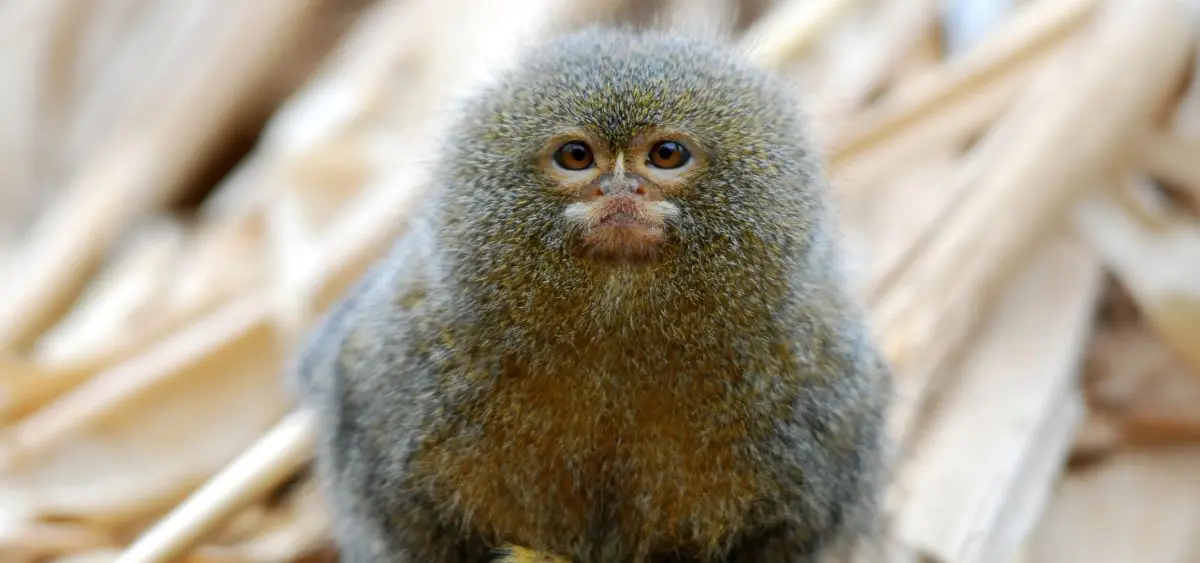
Have you ever imagined a monkey so tiny it could sit on your fingertip? That’s exactly what the pygmy marmoset is like. It’s the smallest monkey in the world and the tiniest true monkey alive today. Because of its size, people often call it a finger monkey or dwarf marmoset. With big eyes, soft fluffy fur, and endless energy, it’s easy to see why animal lovers find them irresistible.
A pygmy marmoset is only 4.6 to 6 inches long, not counting its tail. Its tail can be even longer than its body, helping it balance as it moves through trees. Adults weigh just 3 to 5 ounces, about the same as a small stick of butter. Newborn babies are even smaller, around the size of a human thumb. Their sharp claws help them cling to tree bark, and they can turn their heads almost all the way around to stay alert in the forest.
Even though they’re the smallest monkeys, some lemurs are actually smaller overall among primates. Pygmy marmosets have golden-brown fur mixed with gray and black shades, which helps them blend into trees. They can leap up to 16 feet from branch to branch, which is pretty amazing for such a tiny animal.
Where Do Pygmy Marmosets Live?
Pygmy marmosets live deep in the Amazon rainforest, especially near rivers and floodplain forests. You can find them in Brazil, Peru, Colombia, Ecuador, and northern Bolivia. They love areas with dense greenery, bamboo, and tall trees because these places give them food and safety. Each family group sticks to a very small area, sometimes less than half an acre and often uses the same few trees for feeding every day. Although deforestation is a growing problem, pygmy marmosets can sometimes survive in secondary forests if their favorite gum-producing trees are still there.

What Do These Tiny Monkeys Eat?
Pygmy marmosets are special eaters called gummivores, meaning they mainly eat tree sap and gum. They use their sharp lower teeth to bite holes in tree bark and then lick the sap that flows out. One group can make over 1,000 holes in a single tree! Along with sap, they also eat insects, especially butterflies attracted to the sap, plus fruits, nectar, and small spiders. Their bodies are built for this diet. A large digestive organ helps them slowly break down tough tree gum. Family members often share feeding spots and fiercely protect their favorite trees.
Life Inside a Pygmy Marmoset Family
Pygmy marmosets live in close family groups of 2 to 9 members, usually around five. A dominant male and female lead the group and often stay together for life. Everyone helps—raising babies, grooming each other, and keeping watch for danger. They communicate using high-pitched sounds, squeaks, and even ultrasonic calls that humans can’t hear. Scent marking and facial expressions also play a big role in bonding. When threatened, these tiny monkeys press flat against tree trunks like squirrels or quickly leap away. Predators like snakes, hawks, eagles, and wild cats keep them on constant alert.
Pygmy Marmoset Babies: Tiny but Precious
After about 4.5 months, pygmy marmosets usually give birth to twins, though triplets sometimes happen. Each baby weighs around 15 grams and clings tightly to family members. The father does most of the carrying, bringing the babies to the mother for feeding. Older siblings help too. This strong family teamwork greatly improves survival chances. Babies are weaned at around three months and fully grown by two years. Watching a baby pygmy marmoset ride on its father’s back is one of the sweetest sights in the wild.
How Long Do Pygmy Marmosets Live?
In the wild, pygmy marmosets usually live 10 to 12 years. In protected environments with good care, they can live up to 18 years or more. Life in the wild is risky, especially for babies, due to predators, falls, and habitat loss.
Why Do Pygmy Marmosets Need Protection?
Sadly, pygmy marmosets are facing serious threats. Both western and eastern pygmy marmosets are listed as Vulnerable on the IUCN Red List. Their numbers have dropped by more than 30% due to deforestation, farming, mining, illegal pet trade, and human settlements. They are especially vulnerable because they depend on specific trees near rivers. The illegal pet trade is another big problem, these monkeys don’t survive well outside their family groups. Protecting rainforests, stopping wildlife trafficking, and spreading awareness are key to saving these tiny primates.
Conclusion
The pygmy marmoset may be tiny, but it plays a big role in nature. These miniature monkeys help control insects and support forest health. And let’s be honest, one look at pygmy marmoset photos is enough to make anyone smile. They remind us that even the smallest animals matter. Protecting their rainforest homes ensures future generations can continue to admire the smallest monkey on Earth. The pygmy marmoset isn’t just cute, it’s a powerful symbol of the beauty and fragility of the wild.
Also, read: The Glitter That Costs Childhoods: Dark Truth of Mica Mining
Also, read: The Power of “Reduce, Reuse, Recycle”: Making Every Resource Count
Also, read: The Rise of the Circular Economy: How Tech is Reducing Waste
Also, read: Water Disappearing Without a Trace? Blame Evapotranspiration!
Also, read: The Shocking Benefits of Repurposing You Never Knew About!
Also, read: Sustainable Fashion Hacks: Stylish Choices That Help the Earth